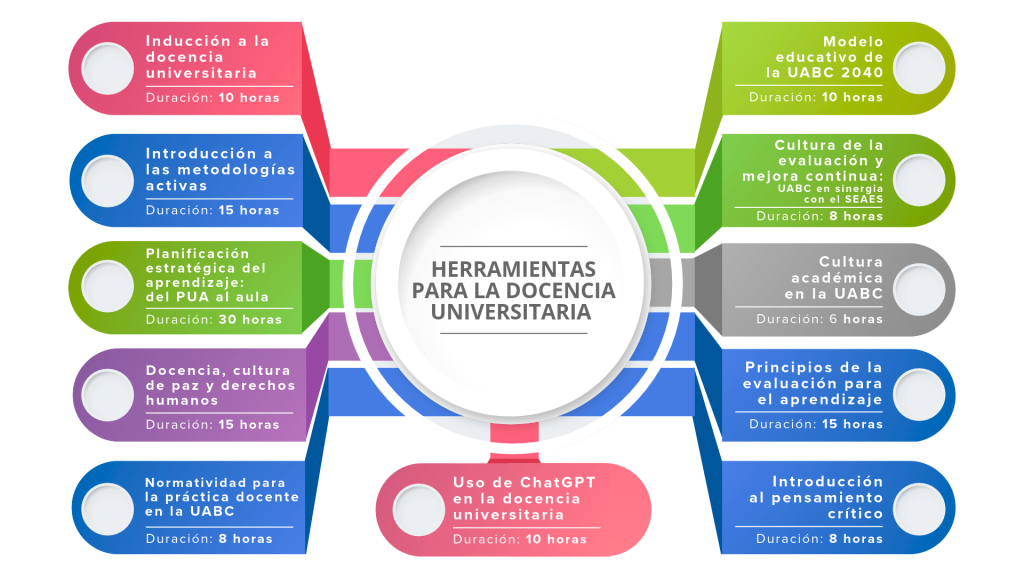
The Diploma in Tools for University Teaching is a 133-hour training program, designed to strengthen teaching performance in the university context. Throughout eleven modular and self-administered courses, participants will develop fundamental knowledge, skills and attitudes for the exercise of effective, ethical, critical and innovative teaching.
The topics addressed in the diploma include: introduction to university teaching, UABC educational model, didactic planning, critical thinking, active methodologies, learning evaluation principles, inclusive evaluation, educational uses of ChatGPT, culture of peace and rights human rights, as well as the culture of evaluation and continuous institutional improvement in coordination with the Higher Education Evaluation and Accreditation System (SEAES).
This diploma responds to the need to offer basic, coherent and relevant training for university teachers, especially in their initial stage. In an educational environment in constant transformation, marked by the challenges of digitalization, inclusion, equity and accountability, it is essential that teachers have conceptual and methodological tools that guide their practice towards continuous improvement and comprehensive training of students.
The structure of the diploma is based on a critical and contextualized vision of university teaching, based on the UABC educational model, integrating current approaches such as competency-based teaching, critical thinking, a culture of peace, and the use of emerging technologies, to contribute to the fulfillment of the institutional mission and the improvement of teaching-learning processes in higher education.
Download the Diploma program
The purpose of the Diploma in Tools for University Teaching is for the participating teachers to develop the basic skills necessary to carry out a reflective, ethical, innovative teaching practice aligned with the educational model of the Autonomous University of Baja California (UABC), through the strengthening knowledge, skills and attitudes in key areas such as didactic planning, critical thinking, active methodologies, the evaluation of learning, the integration of emerging technologies, the culture of peace and processes of continuous institutional improvement.
This diploma constitutes an essential component within the comprehensive teacher training and evaluation program of the UABC, by addressing fundamental dimensions of academic work in higher education, such as pedagogical commitment, methodological innovation, educational inclusion, the ethical use of technology, and university social responsibility.
At the end of the diploma, participants will have a strengthened professional profile, capable of:
- Design didactic plans aimed at meaningful and competency-based learning.
- Implement student-centered pedagogical strategies, based on active methodologies.
- Promote critical thinking and ethical and collaborative participation in the university classroom.
- Evaluate student learning in a fair, inclusive and formative way.
- Incorporate digital tools such as ChatGPT to enrich your teaching practices.
- Promote educational environments with a focus on human rights, inclusion and a culture of peace.
- Understand and actively participate in institutional evaluation processes and continuous improvement.
The diploma is designed under a self-administered online modality, which allows participants to advance at their own pace, with flexibility and autonomy. It is made up of 11 courses distributed in a modular way, each with interactive activities, key readings, reflection exercises and diagnostic and final evaluations.
Methodological approach:
1
Autonomous learning: Self-directed learning is promoted through interactive resources and learning guides.
2
Competency-based approach: Each course is aligned with a specific competency that guides the expected learning.
3
Integration of educational technology: The use of tools such as ChatGPT is promoted to enrich teaching design and promote innovation.
4
Humanistic and transformative perspective: The culture of peace, human rights and the institutional commitment to continuous improvement (SEAES) are incorporated.
5
Final evaluation per course with automated feedback.
- 100% of the training activities proposed in each of the 11 courses that make up the diploma must be carried out.
- The minimum passing grade for each course is 70.
- Courses must be completed in a maximum of 2 years, otherwise the course
older must be retrained.
Curriculum Map