
Degree in Communication Sciences
Duration: 8 semesters
Modality: Face-to-face
Call: Annual
Faculty of Human Sciences, Mexicali.
+52 (686) 557-92-00
+52 (686) 557-84-88
Faculty of Administrative and Social Sciences, Ensenada.
+52 (646) 152-82-29
https://fcays.ens.uabc.mx/licenciatura-en-ciencias-de-la-comunicacion/
Faculty of Humanities and Social Sciences, Tijuana.
+52 (664) 979-75-82
Whoever graduates from the Bachelor of Communication Sciences educational program will be able to work at the local, state, national and international levels carrying out activities in the following sectors:
Public sector:
- Government institutions
- Educational institutions
- Institutes or research centers linked to communication processes
- Non-governmental organizations, civil society associations and non-profit groups
Private sector:
- Media content production and management companies
- Productive companies in the primary, secondary and tertiary sectors
As an independent professional:
- Strategic communication consulting
- Audiovisual production
- Advice on the development of innovations and user experiences
- Analysis of communication, information and interaction processes in socio-digital networks
Train entrepreneurial professionals in the field of communication sciences, with scientific, technological and humanistic bases, capable of transforming and developing their productive and social environment.
1
Train free, autonomous and critical individuals with the ability to solve problems, undertake business projects, intervene in the various areas and spheres of the professional field of communication sciences, permanently committed to the learning process, critical, responsible and attentive to opportunities to improve the social, cultural, economic and political conditions of their environment.
2
Develop projects that link the university community with the various spheres of society in order to reciprocally provide information and training resources that improve the conditions and quality of life of Baja Californians from the field of communication sciences.
3
Offer learning experiences that allow the development of the professional and scientific field of communication sciences at a regional, national and international level; incorporating training projects, linked to civil society, industry, academia and public administration.
4
Offer research projects and social dissemination of knowledge, culture and art to promote the harmonious development of Baja California society.
It must possess the following characteristics:
Basic knowledge of:
- Social Sciences
- Humanities
- General knowledge of spelling and syntax of the Spanish language
- Mathematics
- General notions of statistics
- Logic
Skills:
- Analysis capacity
- Mastery and understanding of reading
- Willingness to acquire knowledge in the area of Social Sciences
- Express yourself appropriately orally and in writing
Attitudes and values:
- Interest in the professional practice of communication
- Willingness to establish interpersonal relationships
- Interest in major international, national, regional and local problems
- Responsibility
- Social commitment
- Respect for the diversity of ideas and lifestyles
- Design communication strategies for health and environmental care environment, through the establishment of bridges between theoretical frameworks and the participatory methodological processes, aimed at the management of the quality of life and well-being of society, with creativity, responsibility social and collaborative work.
- Evaluate from communication the crises of public life and citizenship, through critical analysis and empirical investigation of tensions and social, cultural, political and economic complexities faced by a globalized and hyperconnected world, to implement actions that contribute to the solution of these situations or conflicts considering the different actors involved, from critical, respectful thinking open and willing to dialogue.
- Develop media-society interaction experiences, to train active and critical audiences, through management tools and production of content in hypermedia environments, being respectful, responsible and supportive of the community involved.
- Produce media content, using the most recent technologies hypermedia management and production, to provide active access to audiences multiplatform, in a reflective, respectful, responsible and way adhered to strict professional ethics.
- Assess the dynamics of communication in organizations, based on diagnoses of the needs of the actors and their media, design of communication plans and models, for the implementation of strategies communication capable of transforming micro and macro social spheres, with a critical, collaborative attitude and commitment.
- In addition, you must demonstrate English proficiency at A2 level.
Curriculum
| Subject | Credits | Mandatory |
|---|---|---|
| Technologies for the Generation of Knowledge | 6 | ✓ |
| Scientific Thinking in the Social Sciences and Humanities | 6 | ✓ |
| Introduction to Social Sciences | 6 | ✓ |
| Oral Communication Strategies | 6 | ✓ |
| Ethics and Social Responsibility | 6 | ✓ |
| Documentary Research | 6 | ✓ |
| Citizen Training and Diversity | 6 | ✓ |
| Statistics for the Social Sciences | 6 | ✓ |
| Understanding and Writing Academic Texts | 6 | ✓ |
| Human Development and Transculturality | 5 | ✓ |
| Development of Social-Emotional Skills | 5 | ✓ |
| Contemporary Topics in Communication | 6 |
| Subject | Credits | Mandatory |
|---|---|---|
| Visual Language | 6 | ✓ |
| Sound Language | 6 | ✓ |
| Multimedia Design and Script | 6 | ✓ |
| Intercultural Communication | 6 | ✓ |
| Introduction to Communication Studies | 6 | ✓ |
| Fundamentals of Journalism | 6 | ✓ |
| Participatory Methodologies in Communication | 8 | ✓ |
| Semiotics | 6 | ✓ |
| Realization of Sound Content | 8 | ✓ |
| Qualitative Research in Communication | 8 | ✓ |
| Media Ecology, Sociodigital Environments and New Media | 6 | ✓ |
| Journalism | 6 | ✓ |
| Communication, Culture and Power | 6 | ✓ |
| Aesthetics, Narratives and Formats | 6 | ✓ |
| Realization of Photographic Content | 8 | ✓ |
| Fundamentals of Communication in Organizations | 6 | ✓ |
| Quantitative Research in Communication | 8 | ✓ |
| Audience Analysis | 6 | ✓ |
| Complexity | 6 | ✓ |
| Environmental Communication | 6 | ✓ |
| Realization of Audiovisual Content | 10 | ✓ |
| Diagnosis of Communication in Organizations | 6 | ✓ |
| Analysis and Interpretation of Communicative Data | 6 | ✓ |
| Advanced Writing | 6 | |
| Collective Memory, Orality and Everyday Life | 6 | |
| Cinematographic Narratives | 6 | |
| Communication Regulations | 6 | |
| Digital Graphic Production | 6 | |
| Social Photography | 6 |
| Subject | Credits | Mandatory |
|---|---|---|
| Communication and Health | 6 | ✓ |
| Communicative Planning for Public Space | 6 | ✓ |
| Content Management and Design in Socio-Digital Networks | 6 | ✓ |
| Strategic Planning of Communication Projects | 8 | ✓ |
| Communication and Marketing | 6 | ✓ |
| Communicative Intervention in Public Space | 6 | ✓ |
| Entrepreneurship in Communication | 6 | ✓ |
| Implementation and Evaluation of Communication Projects | 6 | ✓ |
| Public Communication of Science and Culture | 8 | ✓ |
| Critical and Participatory Audience Training Projects | 6 | |
| Digital Transformation of Companies | 6 | |
| Communication and Public Relations | 6 | |
| Audiovisual Postproduction Workshop | 6 | |
| Communication and Gender | 6 | |
| Audiovisual Production of Educational and Cultural Content | 6 | |
| Editorial Production | 6 | |
| Portfolio of Communication Projects | 6 |
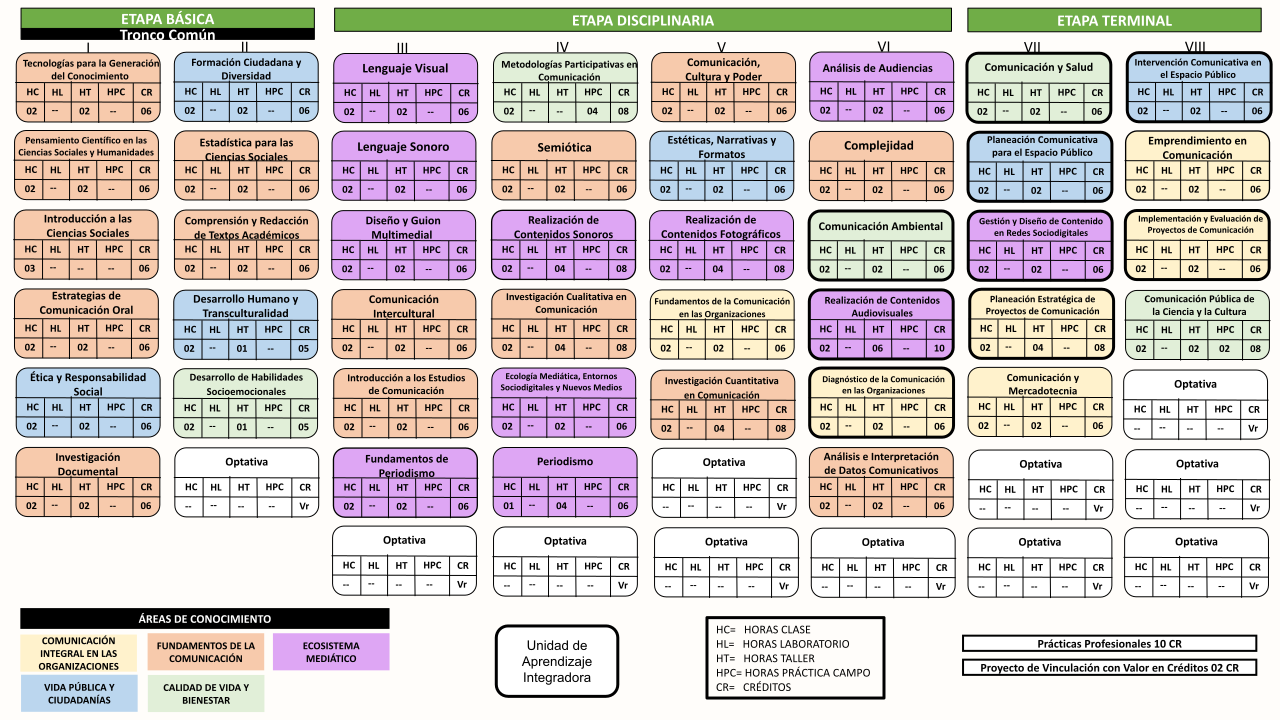
Curriculum Map
Visits: 29,452