Data Engineering and Artificial Intelligence
Duration: 9 semesters
Modality: Online
Call for applications: Annual
Whoever graduates from the educational program Bachelor's Degree in Data Engineering and Artificial Intelligence may work as:
Public and private sector:
- Implements data analysis solutions in government institutions for public management.
- Manages technological infrastructures in public education and health organizations.
- Proposes and evaluates artificial intelligence systems for the optimization of public services.
- Design data analysis solutions to optimize business processes.
- Implement artificial intelligence projects.
- Proposes and evaluates systems based on computational learning for various productive sectors.
- Develop predictive analytics applications to improve decision making.
As an independent professional:
- Provides consulting and training in data analysis and artificial intelligence.
- Create customized technology solutions for companies and organizations.
- Undertakes the development of applications and services based on artificial intelligence and data science.
To achieve this, the following specific objectives are established
1
Develop innovative solutions applying advanced data engineering and artificial intelligence models.
2
Increase linkage actions with the various productive and social sectors, discipline, honesty and respect for diversity.
3
Manage technological systems ensuring scalability, monitoring and continuous updating.
4
Promote the creation of innovative technological projects that, through the interdisciplinary use of acquired knowledge, promote economic and social development.
Whoever wishes to enter the Bachelor's Degree in Software Development must have the following characteristics:
General Knowledge in the areas of:
- Math
- Logic
- Text writing
Skills:
- Oral and written communication.
- Hardware and software management.
- Ability to analyze and synthesize information.
- Operate computer equipment and mobile devices.
- Self-learning.
- Logical reasoning.
Attitudes and Values:
- Be inclusive
- Commitment to quality
- Interest in research and problem solving
- Willingness to work as a team
- Discipline and organization to work
- Trust
- Creativity
- Honesty
- Humility
- Justice
- Loyalty
- Freedom
- Perseverance
- Respect
- Responsibility
- Solidarity
- Tolerance
- Lead and design strategic projects based on the characteristics and needs of social and business organizations, using business models and applying artificial intelligence techniques, data analysis and use of technological tools in a creative way to improve and optimize processes, and provide data for decision making, with innovation, interdisciplinary approach, social responsibility, taking into account the guidelines and ethical principles of the use of artificial intelligence.
- Implement technological solutions by applying advanced computing tools for data analysis, artificial and business intelligence, office suites, and cloud services and infrastructure to solve complex problems and optimize processes in business industrial environments, public and government organizations, with ethics and responsibility. through teamwork, effective communication and adaptability.
- Manage artificial intelligence and data engineering technological infrastructure, for the monitoring, evaluation and scaling of an organization's processes, with responsibility, objectivity, honesty and confidentiality.
- You must also demonstrate command of English through the following options a) Accredit courses up to level V taught by the Continuing Education Center or the academic unit of the UABC. b) Be assigned at least level VI of the language diagnostic exam foreign applied by the General Coordination of Student Services and School Management of the UABC. c) Proof of having obtained at least 43 points in the TOEFL-iBT exam, or at least 460 points in the TOEFL-iTP exam, or at least level B1 of the Common European Framework of Reference or its equivalent, with a validity no more than 3 and a half years. d) Accreditation of the foreign language graduation exam, which is applied at the Faculty of Languages of the three UABC campuses. e) Have accredited formal studies in a foreign language in educational institutions in Mexico or abroad, where they present certificates of diplomas or upper secondary or higher education.
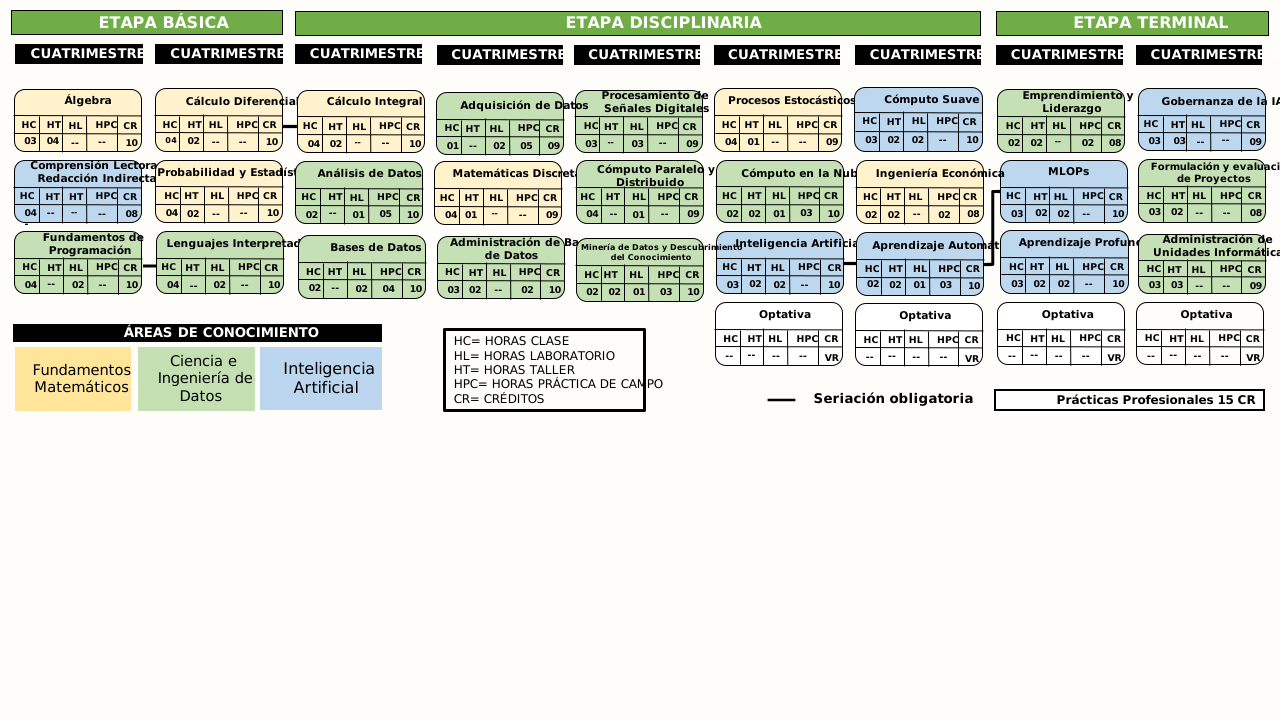
Curriculum
| Subject | Credits | Mandatory |
|---|---|---|
| Algebra | 10 | ✓ |
|
Reading Comprehension and Indirect Writing |
8 | ✓ |
|
Fundamentals of Programming |
10 | ✓ |
| Differential Calculation | 10 | ✓ |
| Probability and Statistics | 10 | ✓ |
| Interpreted Languages | 10 | ✓ |
| Subject | Credits | Mandatory |
|---|---|---|
| Integral Calculation | 10 | ✓ |
| Data Analysis | 10 | ✓ |
| Databases | 10 | ✓ |
| Data Acquisition | 9 | ✓ |
| Discrete Mathematics | 9 | ✓ |
|
Base Administration Data |
10 | ✓ |
|
Signal Processing Digital |
9 | ✓ |
| Parallel and Distributed Computing | 9 | ✓ |
|
Data Mining and Discovery of Knowledge |
10 | ✓ |
| Stochastic Processes | 9 | ✓ |
| Cloud Computing | 10 | ✓ |
| Artificial Intelligence | 10 | ✓ |
| Soft Computing | 10 | ✓ |
| Economic Engineering | 8 | ✓ |
| Machine Learning | 10 | ✓ |
| Generative AI | 8 | |
| Intelligent Agents | 8 | |
|
Approaches and Topics Specialized Data Analysis |
8 | |
|
Technical Communication for Data Science and Artificial Intelligence |
8 |
| Subject | Credits | Mandatory |
|---|---|---|
| Entrepreneurship and Leadership | 8 | ✓ |
| MLOPs | 10 | ✓ |
| Deep Learning | 10 | ✓ |
| AI Governance | 9 | ✓ |
|
Formulation and Evaluation of Projects |
8 | ✓ |
|
Unit Administration Computer science |
9 | ✓ |
| Robotics | 8 | |
| Big Data | 8 | |
| Artificial Vision | 8 | |
|
Selected Topics of Emerging Technologies |
8 | |
|
Ethics and Privacy of the Information |
9 | |
| Computer Networks | 10 |
Curriculum Map